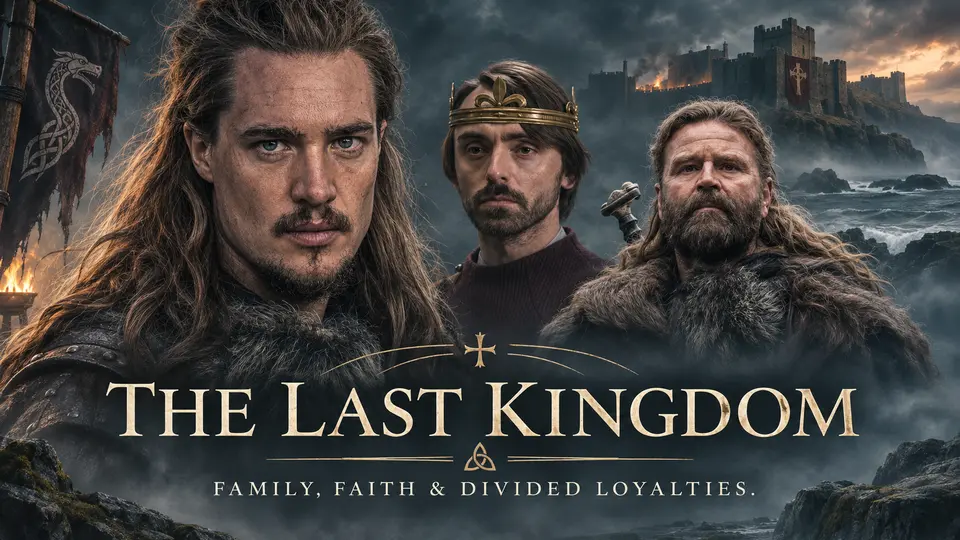
This atlas follows the original Vikings television series through all six seasons. It contains major spoilers and excludes Vikings: Valhalla. Its family relationships belong to the drama, whose chronology and parentage sometimes differ markedly from historical accounts and medieval traditions.
Ragnar and Lagertha's marriage produces the acknowledged family of Bjorn and Gyda before ending in divorce. Rollo later claims to be Bjorn's biological father, but Bjorn rejects that claim and identifies Ragnar as his father. The diagram preserves that uncertainty rather than resolving it as a genetic fact. Ragnar's marriage to Aslaug links four further sons: Ubbe, Hvitserk, Sigurd and Ivar. Lagertha's killing of Aslaug turns a struggle for Kattegat into an inherited grievance.
The brothers initially unite to avenge Ragnar, then divide over leadership, strategy and allegiance. Ivar kills Sigurd, challenges Bjorn and alternately binds Hvitserk to him or drives him away. Ubbe pursues settlement, diplomacy and exploration. Bjorn's marriages connect the next generation through Torvi, Hali and Asa, while Gunnhild and Ingrid become central to Kattegat's later succession. Torvi's later marriage to Ubbe belongs to a different period, not a simultaneous household with Bjorn.
Rollo's marriage to Gisla anchors a Frankish alliance. Harald's ambition brings him into cooperation and rivalry with Ragnar's heirs, even dividing him from Halfdan. In England, Ecbert, Aethelwulf and Judith form the royal setting in which Alfred rises. Alfred's biological father is Athelstan in the television story; Aethelred is his maternal half-brother. Ubbe's alliance with Alfred offers a different future from Ivar's warfare. The Rus connection with Oleg expands that conflict before collapsing from within.
Pink lines identify marriages across time; blue arrows point to children. Purple labels distinguish friendship, conflict, diplomacy and other ties. This is a selected cast, not an exhaustive genealogy of every spouse and child.